Color Scheme

Ben Judah: We’ve heard a lot about what Keir...

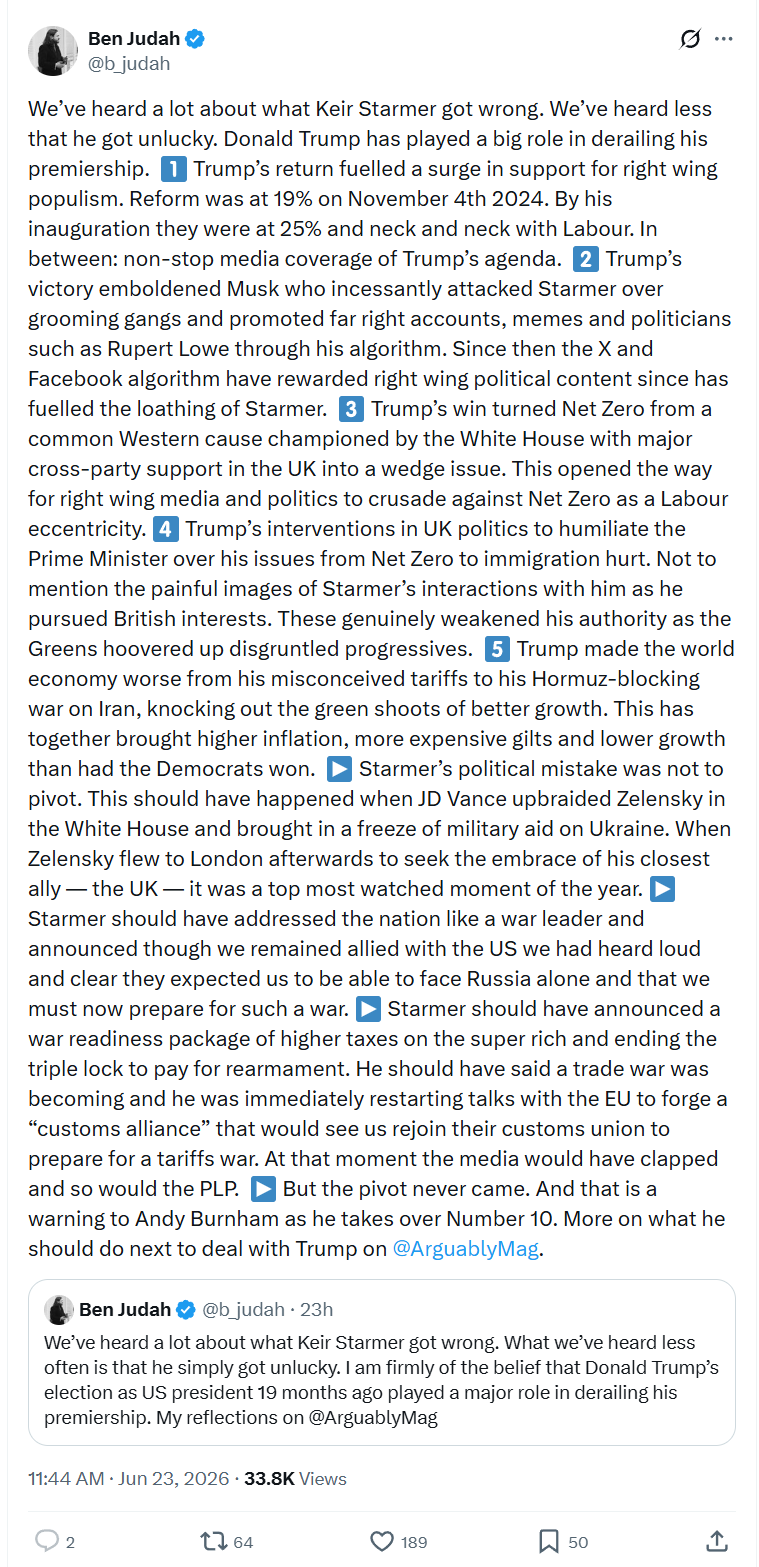
We’ve heard a lot about what Keir Starmer got wrong. We’ve heard less that he got unlucky. Donald Trump has played a big role in derailing his premiership. 1️⃣ Trump’s return fuelled a surge in support for right wing populism. Reform was at 19% on November 4th 2024. By his inauguration they were at 25% and neck and neck with Labour. In between: non-stop media coverage of Trump’s agenda. 2️⃣ Trump’s victory emboldened Musk who incessantly attacked Starmer over grooming gangs and promoted far right accounts, memes and politicians such as Rupert Lowe through his algorithm. Since then the X and Facebook algorithm have rewarded right wing political content since has fuelled the loathing of Starmer. 3️⃣ Trump’s win turned Net Zero from a common Western cause championed by the White House with major cross-party support in the UK into a wedge issue. This opened the way for right wing media and politics to crusade against Net Zero as a Labour eccentricity. 4️⃣ Trump’s interventions in UK politics to humiliate the Prime Minister over his issues from Net Zero to immigration hurt. Not to mention the painful images of Starmer’s interactions with him as he pursued British interests. These genuinely weakened his authority as the Greens hoovered up disgruntled progressives. 5️⃣ Trump made the world economy worse from his misconceived tariffs to his Hormuz-blocking war on Iran, knocking out the green shoots of better growth. This has together brought higher inflation, more expensive gilts and lower growth than had the Democrats won. ▶️ Starmer’s political mistake was not to pivot. This should have happened when JD Vance upbraided Zelensky in the White House and brought in a freeze of military aid on Ukraine. When Zelensky flew to London afterwards to seek the embrace of his closest ally — the UK — it was a top most watched moment of the year. ▶️ Starmer should have addressed the nation like a war leader and announced though we remained allied with the US we had heard loud and clear they expected us to be able to face Russia alone and that we must now prepare for such a war. ▶️ Starmer should have announced a war readiness package of higher taxes on the super rich and ending the triple lock to pay for rearmament. He should have said a trade war was becoming and he was immediately restarting talks with the EU to forge a “customs alliance” that would see us rejoin their customs union to prepare for a tariffs war. At that moment the media would have clapped and so would the PLP. ▶️ But the pivot never came. And that is a warning to Andy Burnham as he takes over Number 10. More on what he should do next to deal with Trump on @ArguablyMag .
Ben Judah: We’ve heard a lot about what Keir...
https://x.com/b_judah/status/2069340835146060259?s=20

Ben Judah: How is this chart hiding Brexit...

How is this chart hiding Brexit damage? The first trick here is indexing everyone at 100 in 2016 at the moment of the shock to the 🇬🇧. The second is to measure the flow not the stock of accumulated investments. That lets you hide the fact 🇬🇧 stock is permanently smaller behind a graph just showing the flow of new investments is increasing. In layman’s terms: let’s imagine you were getting 5% a year salary increases in the years leading up to 2016 above those of your peers. The shock in 2016 then reduces that to a similar level to them or below. What a chart of investment flows indexing everyone in 2016 at 100 does is just show you afterwards creeping up in line with the rest of them — it hides the years of accumulated funds you would have had without Brexit. Clever! That’s how you hide 🇬🇧 business investment is 12-18% below where comparator economies predict it should be — per CEPR’s December 2025 synthetic control analysis of 33 advanced economies. Or the fact, quoted below, 🇬🇧 business investment was down 16.2% on the eve of the pandemic on the OBR’s own pre-referendum expectation. No control group required for that.

Ben Judah: You will see Brexiteers cling to the argument…

▶️ You will see Brexiteers cling to the argument that because the 🇬🇧 grew recently at a similar rate to 🇫🇷 and 🇩🇪 there is no Brexit damage. ▶️ But economists at @GoldmanSachs , @nberpubs and others are not measuring the outcome but rather modelling what 🇬🇧 itself would have achieved had it not done Brexit: i.e. no new trade barriers and no new red tape with our larges market. ▶️ Every serious organisation that has modelled this has found a significant and growing Brexit drag on where the 🇬🇧 economy like have been otherwise. ▶️ What they are saying is we’ve weakened the 🇬🇧 economy to be like 🇫🇷 and 🇩🇪 when we should be growing much faster. ▶️ This is what @nberpubs found in its 2025 paper — “The Economic Impact of Brexit” by Bloom, Bunn, Mizen, Smietanka & Thwaites: 1️⃣ “By 2025, Brexit had reduced 🇬🇧 GDP by 6% to 8%, with the impact accumulating gradually over time” 2️⃣ “Investment was reduced by between 12% and 18%” 3️⃣ “Employment by 3% to 4% and productivity by 3% to 4%” 4️⃣ “These forecasts were accurate over a 5-year horizon, but they underestimated the impact over a decade” “These large negative impacts reflect a combination of elevated uncertainty, reduced demand, diverted management time, and increased misallocation of resources from a protracted Brexit process.” ▶️ How much has this cost us by these calculations? Some £180–240 billion.

Ben Judah: There is a lack of seriousness in the Franco-British plan…

There is a lack of seriousness in the Franco-British plan for a Maritime Coalition to “unblock the Straits of Hormuz.” It will only operate —“with Iranian permission.” Our Gulf partners don’t need us to do deals with Iran to reopen the Straits. They can do that on their own. Presenting what are essentially media and Trump management plans like this as a serious endeavour in the Gulf to allies who can see through them undermines our credibility. Better modesty and honesty: we can offer some maritime support once others make a deal to help drive down maritime insurance. https://gov.uk/government/news/uk-and-france-to-lead-multinational-strait-of-hormuz-military-planning-conference#:~:text=At%20the%20Summit%2C%20they%20called,and%20conduct%20mine%20clearance%20operations.

Ben Judah: What’s happening now is not just a crisis…

What’s happening now is not just a crisis of leadership in the Labour Party — it’s a crisis of ideas, a crisis of policy and a crisis of faith — what is the program to turn the country around? The Prime Minister’s challenges are right to call out this lack of a project has been his great failing. But I don’t see any of them presenting more than competing poll numbers for now. This is, in a way, even more concerning.

Ben Judah: Starmer's authority is now crumbling…

Starmer's authority is now crumbling. But even those most committed to a new Prime Minister should pause for thought about what it means for Britain in the world. For all his many, many domestic missteps, Keir Starmer has genuinely led on Ukraine, make tough calls with Trump and rebuilt relations with Europe by working intensely with President Macron and Chancellor Merz. Labour in government was shocked at how quickly it was swamped by foreign affairs from Gaza and Ukraine, to Trump and Iran. This isn't going to change. However Starmer's challengers have no foreign policy experience, no geopolitical worldviews, no foreign affairs teams and no experience in explaining our place in the world and its tumult to the public. But if they succeed that will be half their job. What's the plan for a geopolitical pivot to Europe? What's the strategy to deal with Trump and our fragmenting Western alliance as China's Axis of Authoritarians deepens? What's next for Britain's extensive diplomatic and security role when it comes to Ukraine? Who will be maintaining key connections to the White House? Changes at the top are often necessary. But they are delicate and not cost free internationally. In diplomacy so much is bound up in personal connections and trust built up over time. Building since 2016, these musical chairs at the top have now become so intense, with Prime Ministers lasting roughly two years and Foreign Secretaries now annuals, our allies and partners are frustrated. I've heard from European and Gulf leaderships first hand it is hardly worth investing diplomatically in a counterpart who's suddenly gone and thus hardly worth investing in Britain.

Ben Judah: I am, like most British Jews, growing...

I am, like most British Jews, growing really frustrated with this vague talk about “division and unity and hate.” We have a very specific problem here. An IRGC cut out is recruiting disaffected Islamist-radicalised men, many long known to the police and negligently left ambling about, to a conduct a targeted intifada against the London Jewish community. And both our counter intelligence and counter terror forces are failing to intercept them. I don’t need a mass London rally of well wishers or cultural luminaires to post their wishes — nice as that is — I need an actual security strategy to clamp down on this so my community can go about our lives in peace as is our absolute minimum right. And I need politicians to call the problem for what it is — not good vibes.

Ben Judah: I want to stress British Jews…

I want to stress British Jews are super concentrated in NW London. there are only 250k of us. Roughly around 100k of us live in this area and surrounding areas. It’s like a small town that’s now under sustained attack. This is the heart of the community and every connected Jew across the country will ties, friends, family here. It’s not felt like disjointed and episodic attacks but like small town the size of Worcester is under attack by an IRGC-cut out.

Ben Judah: Reflecting on the State Visit to Washington…

Reflecting on the State Visit to Washington, there are only really two interesting things left to say about it. The first is to note the Royal Family’s rising importance in our diplomacy since the death of Elizabeth II. This is because of the rise of two sets of politicians: Gulf monarchs who view a relationship with the Royal family as part of their identity and pedigree and Trump and his acolytes. In all these encounters the King genuinely matters diplomatically. This has only increased as the political carousel has spun out of control with annual foreign secretaries and biennale Prime Ministers. The second is to note the extraordinary and rising power the King’s Private Secretary has — effectively the King in Whitehall — on all such matters and how these encounters are shaped. Truly the apex of Civil Service power and anonymity that role — entirely beyond Foreign Office influence, let alone an elected official’s scrutiny. I think those roles, with their curious heritage allowances, are by far the most desirable left in the system.